The order, mappedbefore the line was drawn
Before deciding where AI could act on Strata, the whole B2B2C order had to be visible — every role, every stage, every point where it breaks. This is that research: the user model, the end-to-end journey across contract office furniture, and the method that kept the map bigger than any one release.
What this page is
This is the user research and workflow mapping behind Strata's B2B2C — the path a single order takes from a customer arriving at a dealer, through quoting, contract, ordering, payment, shipment tracking, installation and warranty, and back around to a customer survey.
It is a different piece from “Where AI can act inside an order.” That page is the decision — what the AI proposes, where a person reviews, and why one layer was designed and held back. This page is how that decision became decidable: you cannot say where AI should stop until you can see every step it might touch.
The market it sits in is contract office furniture. A few manufacturers sell through many dealers who don’t know each other, so a single order crosses organizations and no participant sees the whole of it. That asymmetry is why a coordination layer is needed at all — and why the mapping had to cover the whole path, not one company’s slice of it.
Read the decision this research made possible →14 identified users, and the three the design is built around
The journey work identified 14 distinct users across the B2B2C. The model was scoped to the 3 driving adoption — manufacturers, dealers and rep groups — designing for their control points rather than trying to solve 25+ pain points at once.
The empathy and journey work went deeper on a fourth, the end user, because the B2C leg of the order runs through them; and a fifth profile, the facility manager, surfaced later in the mapping. Neither widened the adoption target — they sharpened the picture of the order.
Who the board carries
- Dealers — quote, order, and coordinate the order across every vendor on it
- Rep groups — sit between dealers and manufacturers, managing custom projects
- Manufacturers — acknowledge POs, run production, ship, and handle warranty
- End users — the customer receiving the furniture, the B2C leg of the order
- Facility managers — surfaced later as a distinct profile in the mapping
- PM firms and property management — coordinate the workplace project around the order
- Internal roles — account manager / processor, product manager, business analyst, UX/UI, tech lead / integrations, finance ops
The order, stage by stage
The Furniture Journey board walked one order from first contact to post-occupancy. The sequence, and where each stage breaks — in the board’s own words:
Phase 1Sell
- 1
Sales
Opportunity capture and qualification. Hidden or scattered special pricing and contracts — dealers aren’t always aware manufacturers hold special pricing for specific end users, delaying or skewing quotes.
- 2
Design (optional)
Discovery, workplace strategy, schematic design, FF&E specification. Incomplete or changing initial data — headcount, occupancy ratios and requirements shift mid-process, impacting layout and budget.
- 3
Quoting
Generate a proposal from the approved design, apply commercial rules, validate availability and lead times. Pricing and discount rules not visible at quote-building time; unreliable or late availability and lead times, causing re-quoting churn; freight calculated outside the system.
- 4
Contract
Fetch active manufacturer contracts, select and apply the right one, validate eligibility and validity dates. No single, up-to-date source visible in the dealer app for contracts and special pricing; risk of using outdated or misapplied contracts, leading to rework and disputes.
Phase 2Commit
- 5
Deposit Request (optional)
Create a deposit request on the quote or PO, present terms, reconcile it, and gate the next stage. The journey marks deposits as “optional” with no standard criteria for when they are mandatory; manual and late reconciliation between the payment processor, the ERP and the transaction.
- 6
Cash Ordering
Prepare the PO from the approved quote and valid contracts, set cash payment terms, and send it to the manufacturer via an integrated channel or email, depending on partner capability. Coding mismatches between quotes and items; duplicate POs across vendors.
- 7
Cash Application
Payment and remittance intake — ACH, wire, card, check, PSP — matched to accounts receivable, reconciled and posted. Remittances tied to email and not standardized, producing more “unapplied cash” and rework; status misalignment between Strata, OrderBahn and the ERP.
- 8
Vendor Acknowledgment
Compare the manufacturer’s acknowledgment against the PO. Manual, vendor-by-vendor, with inconsistent formats and time-consuming line-item comparison; no two manufacturers use the same format; a short window to catch a mismatch that is often missed.
Phase 3Fulfill
- 9
Shipping and Tracking
Track shipments across carriers and sources. Vendor variability — some use portals, others need calls — and fragmented visibility; vendors often miss delays, which hits installs and cash flow; tracking data is available but seldom used.
- 10
Receiving
Book the delivery in and reconcile against the PO. Timing mismatches with billing; the warehouse struggles with many boxes and labels; identifying which items are in a shipment is “complicated and difficult.”
- 11
Customer Invoice
Invoice the end customer. The vendor may be paid in full before the final customer payment, creating cash-flow risk; confusion when the invoiced price doesn’t reflect the expected special contract.
- 12
Installation
Coordinate the on-site install. Coordination issues arise and missed ship dates disrupt scheduling; the field needs mobile access; the site is not ready or dock constraints were missed.
- 13
Punch (optional)
Resolve the punch list. Common and variable, adding time and cost; manual communication with the manufacturer leaves no formal record; late punch reporting misses vendor terms-and-conditions windows.
Phase 4Close
- 14
Warranty
Handle warranty claims. Support burden with fragmented evidence over email; no structured tracking or targets; coverage requires checking serial numbers.
- 15
Customer Survey
Close the loop. Needs focused questions; feedback tends to cover both the service and the experience.
What each role is up against
The empathy maps pulled the same order apart by who is living it. Each of these is from the board:
Dealer
- Manual acknowledgement — comparing 500–600 line items between a PO and an acknowledgement, by hand.
- High risk of six-figure costs from manual errors in purchase orders or acknowledgements.
- Lost customers due to failure in tracking shipping dates, leading to missed installation deadlines.
- Communication with manufacturers lacks a single source of truth; users refresh screens waiting for updates.
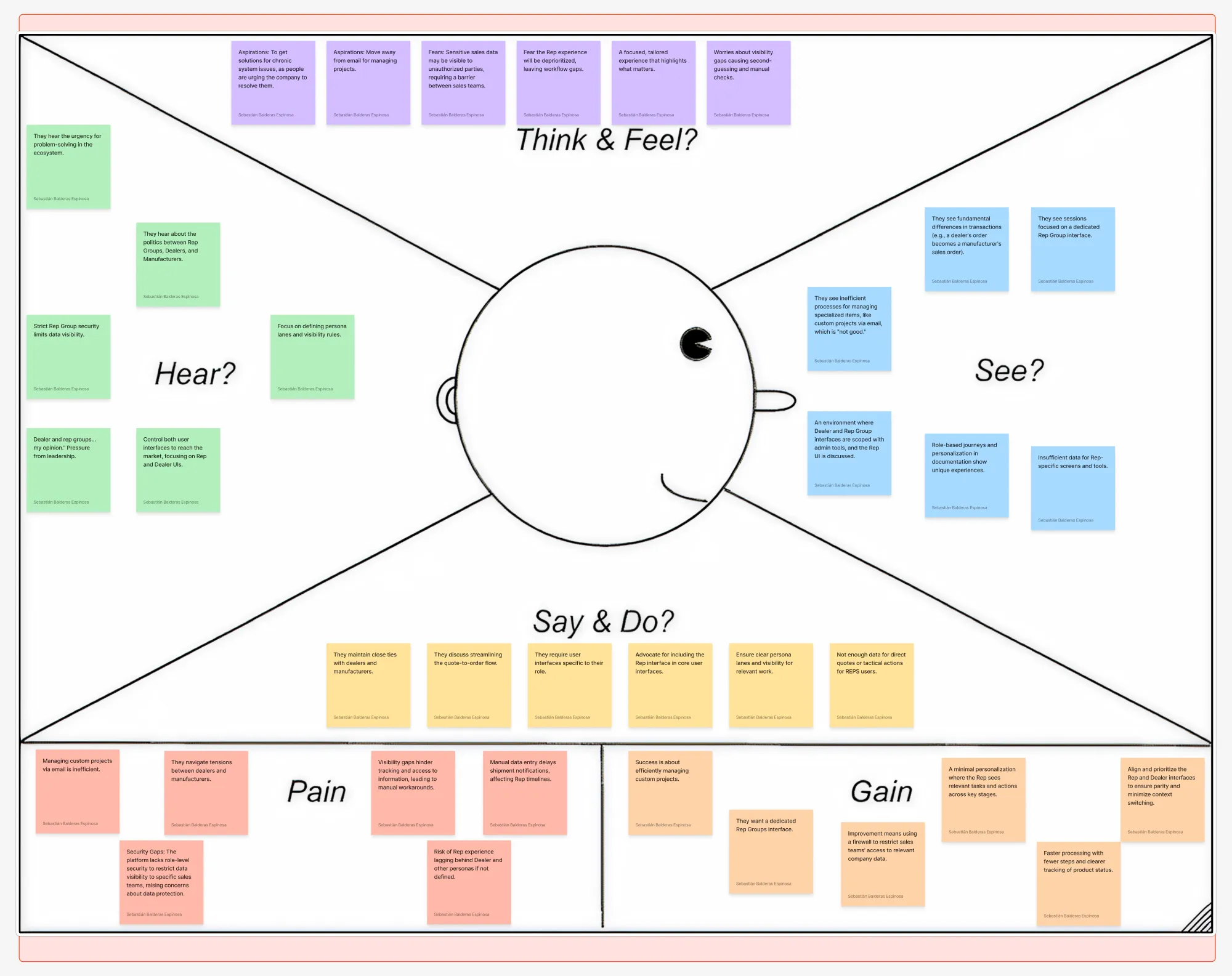
Rep groups
- Managing custom projects relies on email, which lacks tracking.
- Navigating politics between dealers and manufacturers.
- The platform lacks role-level security to restrict data visibility to specific sales teams.
- Manual data entry delays shipment notifications, affecting rep timelines.
Manufacturer
- Every manufacturer has a unique acknowledgment format, forcing time-consuming manual comparisons.
- Unpaid deposits: without payment, production halts, leading to missed deadlines.
- Shipment notifications get sent, but dealers often ignore them, causing repeated inquiries.
- Post-delivery calls about missing installation parts that often end in “no record.”
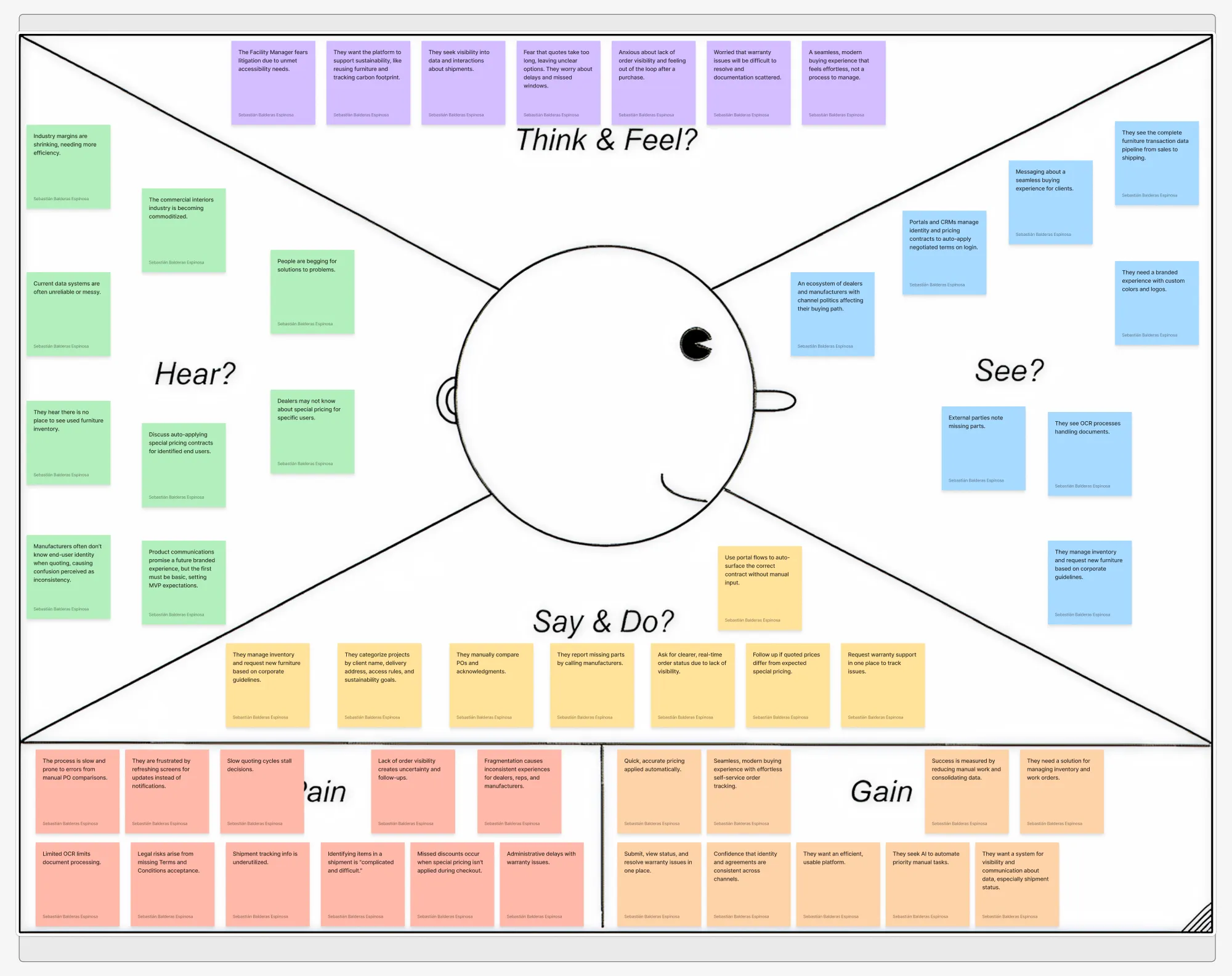
End user
- Manufacturers lack end-user identity, causing pricing inconsistencies.
- Frustrated by the manual comparison of orders and by refreshing screens instead of getting notifications.
- Shipment tracking is available but underused; lack of visibility causes follow-ups.
- Warranty: needs one place to track issues, and coverage means checking serial numbers.
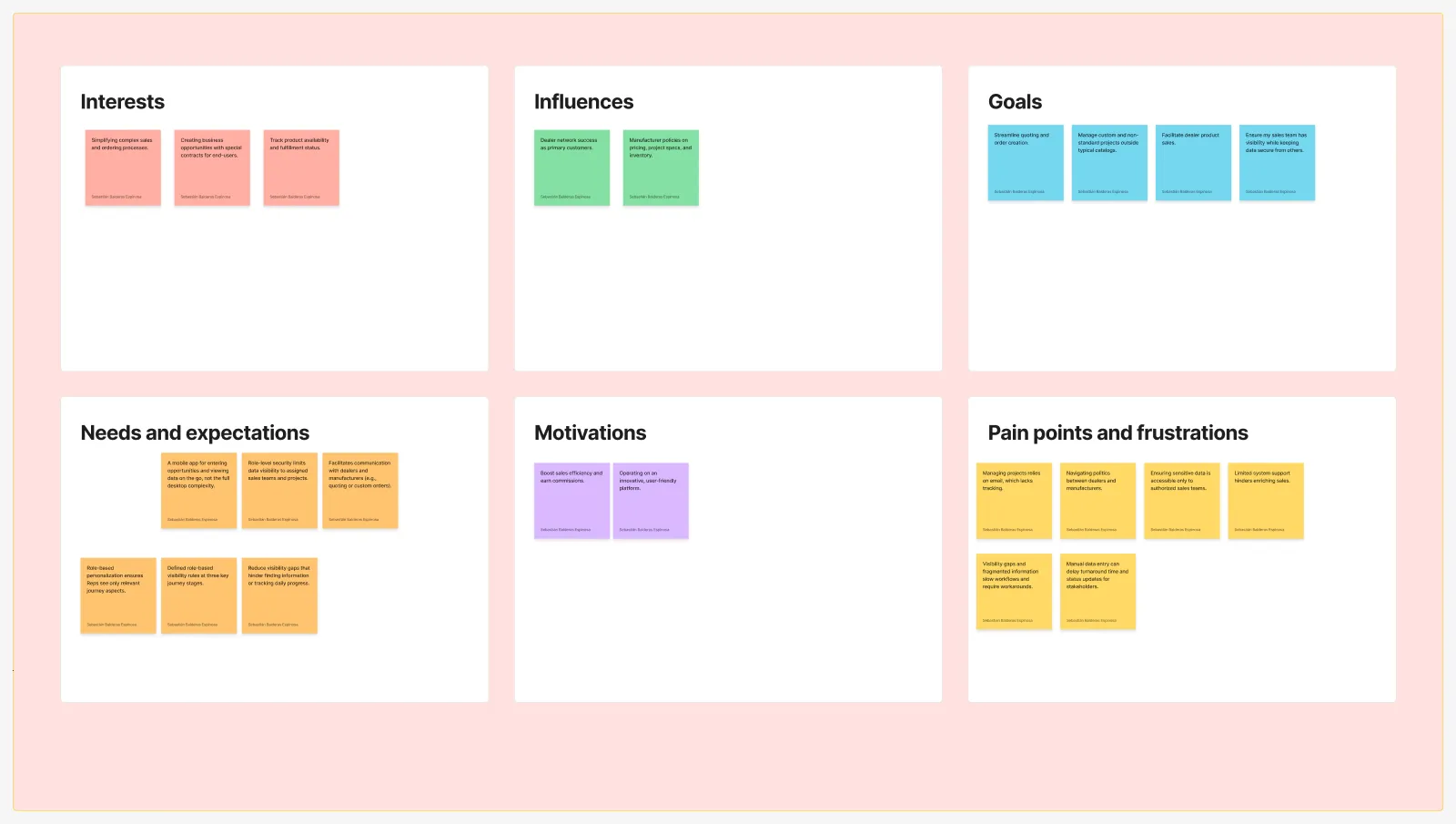
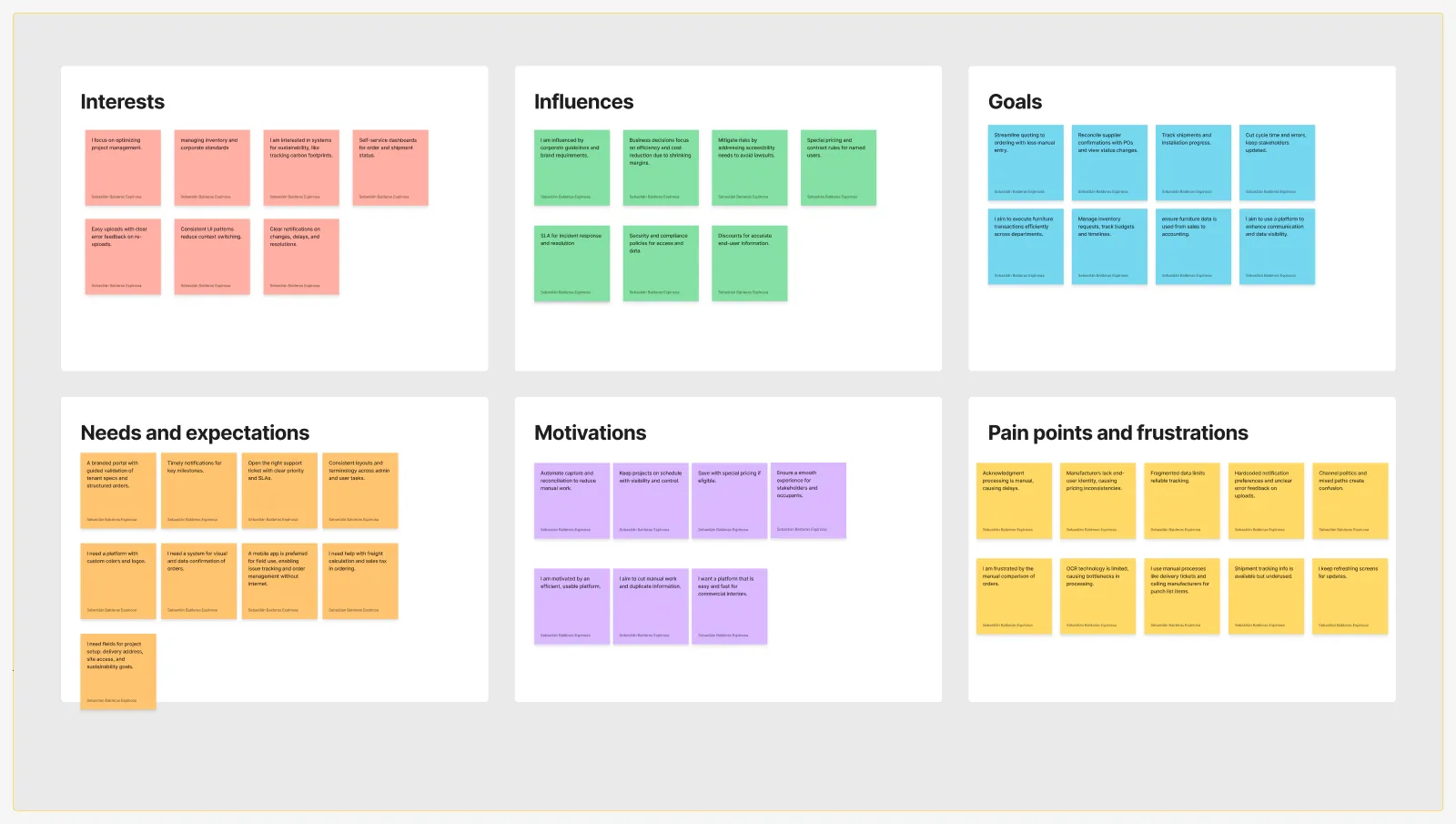
Two roles, from the research board
The board carried an empathy map for every role — think and feel, hear, see, say and do, over pains and gains — and a categorized profile beside it. Two roles' worth, exported:
Rep groups
End user
Design the Ferrari, then take the scooter
The mapping deliberately covered the whole order before anything was cut. The internal name for it was “design the Ferrari, then take the scooter”: model the complete system first — every role, every stage, every automation it could carry — and only then choose what ships first and what waits.
That is why the journey above is longer than any single release. You cannot scope down honestly from a partial picture: the pain points that get deferred still have to be visible, so the deferral is a decision someone can point to rather than an oversight.
The same map is what made the “where can AI act?” decision decidable. You cannot say where a boundary sits until you can see every step it runs through.
What this fed, and what it didn’t
Not all of it shipped as drawn. When Orderbahn’s direction shifted to an AI-first system — Strata — the dealer, rep and installer interfaces built against the earlier scope were made obsolete by that pivot.
That work was not discarded. It became the base for the new UI Kit — the component foundation Strata’s AI-native surfaces were then built on, with the UI-library ownership moving with it.
The research carried forward differently than expected. The current state — the service blueprint — was mapped first; the stakeholder was then asked what needed to change. Each answer became a backlog point, and each point was scoped by what it would take — a design change, an engineering change, a piece of research — before it became a ticket. The role model, the journey and the control points fed the Action Center and the human-and-agent decision boundary that did ship. The screens were redrawn; the map was not.
Why the map stays bigger than the release
You can’t scope a system down honestly from a partial picture. The map has to be bigger than the release, so that everything left out is a decision you can point to — including where a person, not the AI, stays in the loop.
Related
Where this piece connects.
- The full Strata case study →
- Where AI can act inside an order — the decision this research made possible →
A method, not a one-off
On a separate engagement — Repfabric, a CRM/ERP, April 2023 to January 2025 — the same move produced a different number: a 20-role system narrowed to the one persona who drove the sale, with ~85% of legacy functionality removed. Different client, different product, same discipline — map the whole set of actors before deciding who the product is for. Two instances are what make it a method.
The Repfabric case study →Why holding L3 back was the decision:Read the full article on Medium
I write about these decisions in more depth.AI workflow audit, fixed scope:Check the price on Contra